Showing posts with label Birding. Show all posts

Wednesday, November 25, 2009

Tiscornia Park - Photo story

Tim Baerwald found an Ancient Murrelet in southwestern Michigan on the eleventh (see Caleb Putnam's blog for photos and videos from the day it was found). This is a species that is normally spends the winter in the cold waters of the North Pacific off the coast of Washington, British Columbia, Alaska, Kamchatka and Japan (more life history information here). This is an exceptionally rare bird in the Great Lakes (WI has 5 records, this is MI's 9th) and even more exceptional is how confiding and "chaseable" this bird has been (it has been present for two weeks and counting). Most murrelet records are of flybys or just one-day wonders...
Tom Prestby decided that he was going to return from Whitefish Point the long way around the lake in order to see this bird and I decided to meet him over there. I got there at about 11:15AM on the 23rd and within 30 minutes the ten or so birders gathered there with myself were enjoying looks at the bird! Tom arrived shortly thereafter and we spent the next few hours enjoying not only the murrelet but two adult Little Gulls, a subadult Parasitic Jaeger that harassed Bonaparte's and Ring-billed Gulls offshore for about an hour, and a fairly close Red-necked Grebe!
My best digi-scoped shot of the Ancient Murrelet through my Kowa 88.

A typical view of the bird that seemed to spend more time underwater fishing than above!
Another look at the distinctive way murrelets dive with their wings.
I helped this fisherman net this impressive Steelhead from the pier.
Tim Baerwald, the finder of the Ancient Murrelet holding a young Bonaparte's Gull he helped untangle from a different fisherman's line.
The Red-necked Grebe just north of the pier.
After Tom had his fill shooting the murrelet and little gulls I borrowed his new Canon D40 and had fun shooting pretty much everything that flew by (like this Little Gull)!
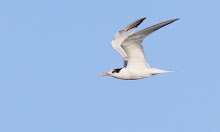
Adult LIGU hovering over the water.Flyby of one of two LIGUs present.
First of many Bonaparte's Gull photos.
BOGU approach.
Another BOGU after grabbing a small fish right in front of us.
A young Bonaparte's showing off their nice contrasting upperwing pattern.
Yet another Bonaparte's Gull (one of my favorite species).
The best shot I managed of the murrelet with Tom's Canon D40.The consolation prize for Tom and I was a stop at New Buffalo where we picked up 3 Lesser Black-backed Gulls (an adult, 3rd winter, and 2nd winter) as well as two adult Thayer's Gulls (THGU being a Michigan bird for Tom and I)! The adult LBBG is on the bottom left and one of the THGU is on the far right and about halfway up (heavily hooded head, dark eye, and the large white apical primary spot).
A beautiful day to be on Lake Michigan in late November!

Sunday, July 12, 2009

Early July Willet

After successfully tracking down one of the California Gulls that has been hanging out at Winthrop Harbor (just south of the WI line) on Friday, I headed north along the lake checking beaches. I managed to bump into my second lakefront Willet of the year (the other being a mid-May bird on Bradford Beach in Milwaukee). It's a tad on the early side for large shorebirds to be going south, so I was pleasantly surprised to find this bird. I was even more impressed at how cooperative it was, allowing fairly close approach and staying very still. The harsh mid-afternoon light and heat waves were the main things I had to cope with. Below are a few of my favorite shots of the 40 or so I managed before it was flushed by a couple other people and flew further up the beach.

Friday, June 12, 2009

Variation in 1st summer Little Gulls

I enjoyed studying two young Little Gulls that have been recently frequenting the Manitowoc Impoundment on June 11th. One of the birds was obviously more advanced in its plumage and showed a mostly hooded head with a prominent white patch on the forehead. This birds dark carpal bars were also much more evident when just scanning over the flock.I was able to get several shots of this bird with its wings up (something I failed to get on the other bird). One of the shots is almost head-on, but the comparison of the LIGUs upperwing and the prominence of the carpal bar in flight really contrasts with the adjacent first summer Bonaparte's Gulls (see right). And finally, here is a shot of three adult male Aythya species in one field of view (LESC on the right). Not something you see everyday in June on Lake Michigan!

Monday, April 13, 2009

Texas trip update


Currently enjoying a hotel room in San Antonio, TX before embarking on the grueling 8 hour drive out to Big Bend National Park tomorrow morning. Thus far the trip has been highly successful garnering each of us (Caleb Putnam, Tom Prestby, and Sam Galick) many lifers and ABA birds.
Below is Tom Prestby's account of our first eight days:

"I spent the last week birding in south Texas with Sean Fitzgerald, Caleb Putnam from Michigan, and Sam Galick from New Jersey. We saw 258 species of birds, by far my highest trip total ever. The following are the day by day highlights:

Sunday, April 5th

Sean and I arrived at the Houston airport a couple hours before Sam and Caleb so we found some green space outside and conducted a stationary count. The biggest surprise was flushing a roosting Chuck-wills-widow from a small hedge nearby, the bird then took shelter in the parking garage of the airport. Doesn’t seem ideal but at least it’s a dark place. A small hawk flight also occurred with numerous Broad-winged and Swainson's and much to my delight a dozen of my lifer Mississippi Kites. Once the group assembled we headed to Galveston and birded there the rest of the day. Here we saw very good numbers of shorebirds, herons, gulls, and terns just about everywhere we stopped.

Monday, April 6th

We started the day birding at Brazos Bend SP where we camped the night before. We woke up to the song of many southern passerines that would be with us for the rest of the trip and eastern hardwood species like Red-bellied and Pileated Woodpecker that we would not see the rest of the trip. In general, warblers were slow-- the highlight was a Prothonotary singing close to our campsite. From here we slowly birded our way down the coast to Aransas NWR. The main highlight along this drive was great views of several White-tailed Hawks. The highlight at Aransas was 2 lingering wintering Whooping Cranes seen from the observation tower- a life bird for all of us. Good numbers of shorebirds, gulls, terns, and ducks were seen from here as well. Scanning the ocean from here yielded us a couple unexpected species like Common Loon, Red-breasted Merganser, and Lesser Scaup. Next, we walked the Rail Trail where we saw our first (of many) Least Grebe of the trip and our only Purple Gallinule of the trip along with many other common marshbirds. We camped at Goose Island SP that night and were treated to a chorus of Paraque and Barred, Great-horned, and Barn Owl as we pitched our tents and went to sleep.

Tuesday, April 7th

We woke up early and started our birding at South Padre Island. We saw some new warblers and other passerines but not nearly as many as we were expecting. We only saw 10 species of warblers on the island. Next stop was Laguna Atascosa NWR. The main habitat here is very dense thicket which is very reminiscent of the tropics. Here we were immediately exposed to many of the south Texas specialties with great looks at species such as Green Jay (on the right), White-tipped Dove, Long-billed Thrasher, Olive Sparrow, and Plain Chachalacha. At Alligator Pond we had great looks at the Masked Duck that has been present for several weeks—another life bird for all of us (it's getting pretty tough for me to pick up new ducks in the ABA area... I think Spectacled Eider is the only other life duck that regularly occurs that I haven't seen). Next, we birded the long auto tour where we saw large numbers of shorebirds, herons, gulls and terns including over 100 Reddish Egrets and quite a few Gull-billed Terns. Technically our rarest bird was a male Greater Scaup that we photographed, this species is fairly rare down there this late in spring.

Wednesday, April 8th

We started the day on Port Isabel Road where we found one of the Aplomado Falcons on its nest, lots of singing Cassin’s Sparrows (left), a very obliging White-tailed Hawk, and good numbers of grasspipers, ducks, and herons. We were stunned to count 43 Least Grebes in just two ponds on this road. We whiffed on Botteri’s Sparrow. Then we went back to Laguna Atascosa NWR where we staked out the no-show pair of Blue Buntings. Next we checked South Padre Island again but the birding was even slower than the previous day. After looking for passerines we walked out on the jetty on the south end of the island and found the Purple Sandpiper (right) that has been lingering with Ruddy Turnstones and Sanderlings. We spent the night at Bentsen SP where we were greeted by Paraques, Lesser Nighthawks, and Eastern Screech-Owls.

Thursday, April 9th

We started at Bentsen where we were awakened by a dawn chorus which included Clay-colored Thrush and Northern Beardless-Tyrannulet (left) among many of the other valley specialties. The hawk tower had a pretty good hawk flight including good numbers of Broad-winged, Swainsons, and Mississippi Kites. A couple Groove-billed Anis hung out in the area below the tower. We spent the early afternoon birding Estero Llano Grande State Park. Even though it was hot and mid-afternoon we did very well finding our target birds- the young male Rose-throated Becard, the Black-throated Magpie Jay (of captive origin but still very cool to see), the nesting Red-crowned Parrots, and my lifer Green Kingfisher in a small creek. Other birds present were both species of Whistling Ducks, a pair of Cinnamon Teal, and several species of shorebirds. We finished the day at the Frontera Audubon Thicket. Good numbers of the Rio Grande specialties were present here but we couldn’t find the lingering Blue Bunting or Crimson-collared Grosbeak.

Friday, April 10th

Started the day back at the Frontera Audubon Thicket. After about a half hour of searching we found the female Blue Bunting in the orchard area. It gave brief but very good views as it fed in some of the grasses (allowing me to digi-bin 3 photos of it, only one of which was reasonably in focus - on the right). We tried for the Crimson-collared Grosbeak for another couple of hours but it never showed up. We moved on to Anzalduas County Park but unfortunately it was closed because of Good Friday. We decided to go to the restaurant/bar next door (Pepe’s on the River) so we could at least watch the river from there. Nothing much on the river but we witnessed a big raptor movement. We saw tons of Swainson’s Hawks (see left - at a straight kettle of SWHA) and very good numbers of Broad-wingeds, Mississippi Kites, Vultures, and a couple Cooper’s and Sharp-shinned Hawks. However, the real surprise came when we were about to leave. As we were opening the car doors we noticed a medium-sized falcon flying at us that was light colored with dark axillaries. We realized this was not a pale large Merlin or small Peregrine but a Prairie Falcon! This was completely unexpected as Prairie Falcon is supposed to be out of the area by the end of March. After this excitement we headed back to bird at Bentsen for the rest of the day but the hot weather put a damper on bird activity. At dusk we heard a pair of Elf Owls but the Ferruginous Pygmy Owl never made a sound.

Saturday, April 11th

We started at dawn on the Rio Grande in Salineno. Much to our dismay, two other birders told us that a pair of Muscovy Ducks had flown by five minutes before our arrival, the worst words a birder could hear. It wasn’t long before multiple Green and Ringed Kingfishers gave close flybys. We also heard several Audubon’s Orioles in the trees near the boat landing and after some waiting a male finally gave us a nice look. Just when the birding seemed to be getting dull around 8:30am the group spotted a large black bird with white wing patches flying towards us from the Mexico side of the river- a female Muscovy Duck! She put on a show by circling over us and flying back to the Mexico side to land in a snag across the river. Only minutes later, a pair of Red-billed Pigeons, our other main target bird here, were spotted in the distance on a snag. At first they were very flighty and uncooperative but they eventually settled down on a snag and provided nice scope views. From here we birded the road that cuts north through desert habitat where we picked up Cactus Wren, Black-throated Sparrow and Pyrrhuloxia among others. It was neat to see a Curve-billed Thrasher nest along the road as well (adult Curve-billed pictured on right). From here we worked our way north to Falcon County Park where we found a pair of Vermillion Flycatcher and Verdin and Falcon State Park where we saw more common desert-associated species including an entertaining Roadrunner. We couldn’t find seedeaters in Zapata or San Ygnacio but we picked up Black Phoebe for the trip. After leaving San Ygnacio at dusk we found a field full of Chihuahuan Ravens which were using the field as a roost site. We counted 963 ravens—a very neat spectacle to witness (Sam clicking below).

Sunday, April 12th

We started at the Zapata Pond but missed Seedeaters again but we did have a nice look at an Ash-throated Flycatcher. Afterwards we tried the Las Palmas trail along the Rio Grande in Laredo but we couldn’t find any Seedeaters here either. We did find my final trip bird though, a male Black-chinned Hummingbird.

I flew back from Laredo yesterday but Sean, Sam, and Caleb went on to the hill country just SW of San Antonio (success on both the warbler and vireo!) and Sean and Sam are continuing all the way to Big Bend NP. I’m sure Sean will post a report from the rest of the trip.

I ended the trip with 10 life birds and another 2 ABA lifers. Congratulations if you made it to the end of this report!

Tom Prestby"


The rest of the trip was a resounding success and Sam and I ended up the trip having seen 314 species in just two weeks moving across TX! The most unusual birds we saw were a high flying migrant Common Black Hawk high above the Chisos Mountains while searching for the elusive Colima Warbler. A very cooperative singing Painted Redstart also in that area. One of the most unusual birds were a pair of Carolina Wrens right along the Rio Grande in Cottonwood Campground. Sam and I didn't think much of it at the time, but it is well NW of where the normally occur in TX... The highlight birds for me personally were seeing Colima Warbler and Common Black-Hawks (pictured below) at close range out at Big Bend NP.

Wednesday, March 04, 2009

Lesser Canada Goose

I've been checking the same stretch of Sugar Creek near Burlington several times a week in the hopes it will yield more interesting geese. The numbers have been quite impressive for the location (over 4500 yesterday evening) but have been low on diversity since I first found Cackling Geese there a couple of weeks ago. Today I saw a goose that was definitely smaller than the surrounding Canada's but whose beak just wasn't small enough for it to make the cut for a Cackling Goose.
It was very interesting when reviewing my photos of the bird of how marked the difference head angle made when comparing the relative length of the beak compared to the width of the head. I cropped in on two images taken one after the other to illustrate this point (both on the left). Not only does the second shot make the bird look smaller beaked but it also appears to accentuate how steep the forehead is on the bird! Now even the second shot appears to have too long of a beak to be a Cackling, but it is reasonably close (comparison head shot of a Cackling Goose on the right that I photographed at the same location on 2/16)! Here are a few more size comparison shots of the Lesser Canada with other Canada's (presumably Giants).

Thursday, February 19, 2009

Birding southern Dane Cty

Tom Prestby and I spent the afternoon searching for open water along the Yahara River in Dane County. We ended the day at the UW Arboretum in search of redpolls (no luck on them surprisingly). We did have a Northern Shrike pop up right over us when we were near Teal Pond. Since it was the only bird I attempted to digi-bin in the freezing cold yesterday, here's the best I managed. I was frustrated in my attempts to keep my hands from shaking and the quality of the image suffered as a result... Here's Tom's summary of the day:
Sean Fitzgerald and I birded some areas south of Madison yesterday and found a
few fairly early arrivals. We started at Mud Lake where all three species of
swans are still present plus the Greater White-fronted Goose and her four
hybrid kin. 2 "textbook" Cackling Geese were also in with the Canadas. 5
Ring-necked Ducks, 4 Canvasback, and 9 Lesser Scaup joined the large numbers of
Goldeneye and Common Mergansers. We also heard White-winged Crossbills and
Siskins as we scanned the waterfowl. There was a flock of blackbirds including
30 Red-wingeds and 5 Cowbirds on Hwy 51 just south of Mud Lake and a Sandhill
Crane in the marshy area where Dyreson road bends. Most of the water on Hwy B
east of Stoughton is frozen but there was a Pied-billed Grebe in the river
itself.

We couldn't find any Redpolls in the UW-Arboretum but we found a Northern
Shrike near Teal Pond and heard White-winged Crossbills in the Longenecker
Gardens.

Tuesday, February 17, 2009

Small geese on the move

This past week has seen a very welcome retreat from single digit temperatures and snow covered ground and even gave the impression of spring. Nearly all of the snow melted away and the day-time high has probably averaged a little over 35 F for the week. Apparently the birds have taken this as their cue to move as blackbirds and waterfowl (geese in particular) have really begun to move north again. I'm afraid their migration will have to take a hiatus as the majority of ponds and flooded fields froze back over only a couple days after they opened up. This has given us the unique opportunity of finding the streams and rivers that are open and going through really nice concentrations of geese earlier in the year than is usual for Wisconsin (late Feb through March sees the bulk of these small geese).
Yesterday my dad and I swung by Sugar Creek near the Burlington Airport and located a pretty decent concentration of ~600 Canada Geese that also had three very small Cackling Geese accompanying them. I was able to take 7 photos of these guys before they flew, of which, three actually show pretty decent detail.The identification of Cackling Geese is not exactly straight forward. There are a whole host of characteristics that could indicate that the bird is a Cackling Goose but only a few that are relatively diagnostic. The size and shape of the beak is one of the best field marks to use. The Cackling Goose is very small and the length of the beak is 50% or less than the width of of the head (compared to 70%+ for Canada Goose). The forehead on a Cackling is also very steep and almost angular compared to the more smoothed over head of the Canada Goose.Other characteristics such as the presence of a white collar at the base of the neck is variable and found in both species. Richardson's Cackling (which is the most likely here in the midwest) also tends to have a lighter colored feathering in the breast.In the above photo it's quite difficult to tell if the left bird has a lighter breast than the adjacent Canada Goose.

This afternoon I checked several other locales for geese and turned up (presumably) the same two Cackling Geese along Sugar Creek near Burlington. They were farther away and despite the light being better, I hadn't brought my scope along so a chance to improve on the above images wasn't really there. I continued on and checked an open area on Honey Creek just over the Walworth County line in between the two small "towns" of Honey Lake and Honey Creek. This particular location has an s-shaped bend in the stream that stays open all winter. At least 200 Canada Geese managed to successfully winter on this small area of open water. I figured they would have attracted many more migrant geese and sure enough, over 1000 geese were present in this stretch of the creek. I was lucky and spotted a group of 4 Greater White-fronted Geese roosting on the ice very close to me and edged up to get better photos (still pretty mediocre...why didn't I bring the scope!?). I took ten shots of the birds (below) and didn't think I would do any better at that distance and I didn't want to run the risk of flushing them if I moved even closer so I turned to leave.
A minute later just as I was getting into my car over half the geese irrupted into the air and came flying right over me. I never saw what prompted them to flush, but I located two of the white-fronts and managed to catch them flying over in the midst of a flock of Canada's. It's good to have these guys back, albeit temporarily, now to find some of those small white geese...

Thursday, January 22, 2009

In search of a Wisconsin rosy-finch!?

This morning Tom Prestby and I both made our first winter visit to Grant County in search of the wayward rosy-finch that apparently has decided that Wisconsin beats Colorado as a winter destination... It only took a couple of u-turns for possible crossbills in spruces before we did find some on the eastern edge of Finnemore in a small (less than 35' tall) clump of spruces in front of a small trailer park. The six crossbills were both our first in Grant County but it wasn't until I returned home that I noticed that the male, who had so cooperatively allowed me to digibin him from the car, actually appears to be injured. His upper mandible lacks the normal decurved tip and looks as if its beak is flaking (see photo above)... I'm not sure if this is the result of a collision with a window somewhere in southern Wisconsin or if this is inevitable as these guys get old.

Tom and I arrived at the guy's house who had originally posted the bird on eBird at 9AM and we settled in for the potentially long wait to see this bird come to their feeders. Shortly after we had arrived Chris West showed up, and over the course of the next 5 hour two other birders swung through (Aaron Holschbach and Tom Schaefer). While we struck out on the desired finch, we did see quite a diversity of other finches in his yard. Among these was a nice male Purple Finch, a few House Finches, good numbers of goldfinch, over 18 Pine Siskins, about a dozen Common Redpolls, and a flock of 15 White-winged Crossbills that briefly stopped to check out a small clump of conifers in the neighbors yard. 6 species of finch in the course of five hours in Grant County (furthest county SW in the state) - wow! Here is a photo of just a small glimpse into the almost constant finch buffet line that these guys had spread out (right).

After we left the rosy-finch location we headed down to Cassville and checked the John Dewey Powerplant in Cassville. The previously reported Trumpeter Swans (12) were still present along with 7 Bald Eagles, 2 Belted Kingfishers, and a good number of Common Goldeneye (45). Eastern Bluebirds were seen at 4-5 different locations within 5 miles of Cassville totaling at least 14 birds.

We headed next to Patch Grove where there had been some good recent reports. We found two different flocks of Gray Partridge totaling 18 birds on both the east and west sides of Breuer Rd (north of Lancaster Rd or Patch Grove Rd). Having only seen this particular species one time in Wisconsin, this was probably the highlight of the day for me (4 of the 18 pictured on the left). The windswept "snowscape" had an almost tundra-like feel to it (closing photo below). The partridge were digging down into the snow then using their feet to kick up the dirt presumably in search of corn or small seeds to eat. I have to give these birds props for being so hardy.
The large flock of 600+ Snow Buntings (with small numbers of accompanying Lapland Longspurs) reported by Dennis Kirschbaum was still present at the intersection of Hickory and Maine to the southwest of Patch Grove.

As we made our way back east we picked up a small group of 7 Brown-headed Cowbirds accompanying some starlings and house sparrows near a "messy farm" east of Preston.

We ended the day with 38 species in Grant County, not too bad for half the day spent staring at a feeding station!