I’ve seen this topic addressed numerous times in various birding periodicals and have always enjoyed the sample photos they have where they ask you to estimate the flock. This is very pertinent to birders as many citizen science projects involve the counting of birds to estimate trends in their entire populations (Christmas Bird Counts, International Shorebird Survey, Great Backyard Bird Count, eBird). When I first began doing counts like these I would take one of two approaches; I would painstakingly go through the entire flock and count every single individual, or I would just guess the number. As I’ve been doing surveys that require counts of many distant flocks I’ve gotten a lot of practice in counting flocks and I now usually will mentally divide a flock into sections and count to ten or 20 and extrapolate how many sections there are represented by the rest of the flock for a fairly accurate estimate of the number. If I have time and I’m able to count every individual I will do this, but many times the viewing conditions don’t facilitate this approach. Over the years I’ve found that even my ball-park guesses of a flock are often not far from the mark. A recent flock of Black-tailed Godwits that were flying past the observation tower at Kariavetti gave me a good illustration of this. They were swirling around and flying by too rapidly for me to even count sections and estimate the flock, but I estimated that there were about 80 birds present. I also was able to get a quick photo of them that I knew I’d be able to go back and count them one-by-one blown up later on my laptop screen.  I was pleased to find that my gut feel on the flock was only one off, there were actually 79 birds in the flock (I welcome anyone’s correction!). So while not exact, I had arrived at a very close estimation by letting my prior experience dictate my estimate.
This weekend I was out at Point Calimere with Relton and he had arranged for us to go out with a student who is working on her pHD on wading birds at this site. I learned quite a bit about BNHS (Bombay Natural History Society) staff and a very different approach to birding through this experience. BNHS is the largest bird organization and primary source of record keeping for all bird records in
The next morning I began to doubt the credibility of the pHD student as she was identifying birds through the scope that I knew were incorrect (distant common greenshanks were labeled as black-tailed godwits). She also apparently was not accustomed to viewing species through the scope at long distance because she refused to believe that the three large distant curlew I had watched fly in and that I had in my scope were Eurasian Curlew, claiming that they were “smaller waders.” At this point I stopped trying to show her things because I didn’t feel like arguing with her. Because of this she missed three (fairly rare) Slender-billed Gulls that flew by in the midst of a large Brown-headed Gull flock.
Later in the day we had driven inland about 20 km to a large lake that we had noticed the previous evening while driving out to the point. The flock of 80 Greater Flamingos that we had seen in the distance the previous night was the primary reason for our return, but we were also curious what the identity of the thousands of shorebirds and terns that had also been noted the previous night. We arrived at the sub-prime time of 4PM and unfortunately the sun was working against us, but we walked out over the rice paddies and began scoping the extensive mud flats. We were pleased to see that the flamingos had called some friends and that flock had multiplied to a very respectable ~500 birds divided among two flocks (115 of which are seen in the closing b&w photo). I was spending my time trying to get identifiable views of the many small and medium-sized shorebirds that were spread out over the flats. Unfortunately the light won this battle and I wasn’t able to turn up any of the hoped for broad-billed sandpipers or stints that I’ve yet to see.
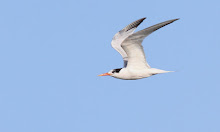
During this time I was half-listening as the BNHS representative was rattling off numbers for each species. Some of the closer species that could actually be individually counted she was right on for, but when she starting estimating distant flocks my curiosity arose at how some of these numbers were being arrived at. The Painted Stork tally that she gave (450) I would say was less than 1/3 of the birds present…they covered the opposite shore for over a kilometer! She also was vastly over-simplifying species composition and gave a blanket estimate of the extremely large mixed tern flock as 3000 Caspian Terns. I could see hundreds if not more of at least 5 other tern species flying around and perched among this flock… She then asked my opinion (apparently I’d proven myself worthy of identifying these birds in her eyes) on a pair of terns that were sitting in the distance. They were definitely a pair of Lesser Crested Terns which are quite a bit smaller than the Caspian Tern which they sort of resemble by the presence of a crest and reddish beak. When I said this she said no that they were River Terns. I was a bit incredulous as this species doesn’t resemble in any way Caspian or Lesser Crested Tern (the only two species that these birds could have conceivably been confused as that are in southern