Thursday, February 19, 2009

Birding southern Dane Cty

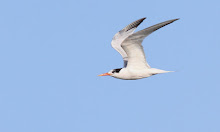
Tom Prestby and I spent the afternoon searching for open water along the Yahara River in Dane County. We ended the day at the UW Arboretum in search of redpolls (no luck on them surprisingly). We did have a Northern Shrike pop up right over us when we were near Teal Pond. Since it was the only bird I attempted to digi-bin in the freezing cold yesterday, here's the best I managed. I was frustrated in my attempts to keep my hands from shaking and the quality of the image suffered as a result... Here's Tom's summary of the day:
Sean Fitzgerald and I birded some areas south of Madison yesterday and found a
few fairly early arrivals. We started at Mud Lake where all three species of
swans are still present plus the Greater White-fronted Goose and her four
hybrid kin. 2 "textbook" Cackling Geese were also in with the Canadas. 5
Ring-necked Ducks, 4 Canvasback, and 9 Lesser Scaup joined the large numbers of
Goldeneye and Common Mergansers. We also heard White-winged Crossbills and
Siskins as we scanned the waterfowl. There was a flock of blackbirds including
30 Red-wingeds and 5 Cowbirds on Hwy 51 just south of Mud Lake and a Sandhill
Crane in the marshy area where Dyreson road bends. Most of the water on Hwy B
east of Stoughton is frozen but there was a Pied-billed Grebe in the river
itself.

We couldn't find any Redpolls in the UW-Arboretum but we found a Northern
Shrike near Teal Pond and heard White-winged Crossbills in the Longenecker
Gardens.

Tuesday, February 17, 2009

Small geese on the move

This past week has seen a very welcome retreat from single digit temperatures and snow covered ground and even gave the impression of spring. Nearly all of the snow melted away and the day-time high has probably averaged a little over 35 F for the week. Apparently the birds have taken this as their cue to move as blackbirds and waterfowl (geese in particular) have really begun to move north again. I'm afraid their migration will have to take a hiatus as the majority of ponds and flooded fields froze back over only a couple days after they opened up. This has given us the unique opportunity of finding the streams and rivers that are open and going through really nice concentrations of geese earlier in the year than is usual for Wisconsin (late Feb through March sees the bulk of these small geese).
Yesterday my dad and I swung by Sugar Creek near the Burlington Airport and located a pretty decent concentration of ~600 Canada Geese that also had three very small Cackling Geese accompanying them. I was able to take 7 photos of these guys before they flew, of which, three actually show pretty decent detail.The identification of Cackling Geese is not exactly straight forward. There are a whole host of characteristics that could indicate that the bird is a Cackling Goose but only a few that are relatively diagnostic. The size and shape of the beak is one of the best field marks to use. The Cackling Goose is very small and the length of the beak is 50% or less than the width of of the head (compared to 70%+ for Canada Goose). The forehead on a Cackling is also very steep and almost angular compared to the more smoothed over head of the Canada Goose.Other characteristics such as the presence of a white collar at the base of the neck is variable and found in both species. Richardson's Cackling (which is the most likely here in the midwest) also tends to have a lighter colored feathering in the breast.In the above photo it's quite difficult to tell if the left bird has a lighter breast than the adjacent Canada Goose.

This afternoon I checked several other locales for geese and turned up (presumably) the same two Cackling Geese along Sugar Creek near Burlington. They were farther away and despite the light being better, I hadn't brought my scope along so a chance to improve on the above images wasn't really there. I continued on and checked an open area on Honey Creek just over the Walworth County line in between the two small "towns" of Honey Lake and Honey Creek. This particular location has an s-shaped bend in the stream that stays open all winter. At least 200 Canada Geese managed to successfully winter on this small area of open water. I figured they would have attracted many more migrant geese and sure enough, over 1000 geese were present in this stretch of the creek. I was lucky and spotted a group of 4 Greater White-fronted Geese roosting on the ice very close to me and edged up to get better photos (still pretty mediocre...why didn't I bring the scope!?). I took ten shots of the birds (below) and didn't think I would do any better at that distance and I didn't want to run the risk of flushing them if I moved even closer so I turned to leave.
A minute later just as I was getting into my car over half the geese irrupted into the air and came flying right over me. I never saw what prompted them to flush, but I located two of the white-fronts and managed to catch them flying over in the midst of a flock of Canada's. It's good to have these guys back, albeit temporarily, now to find some of those small white geese...

Thursday, January 22, 2009

In search of a Wisconsin rosy-finch!?

This morning Tom Prestby and I both made our first winter visit to Grant County in search of the wayward rosy-finch that apparently has decided that Wisconsin beats Colorado as a winter destination... It only took a couple of u-turns for possible crossbills in spruces before we did find some on the eastern edge of Finnemore in a small (less than 35' tall) clump of spruces in front of a small trailer park. The six crossbills were both our first in Grant County but it wasn't until I returned home that I noticed that the male, who had so cooperatively allowed me to digibin him from the car, actually appears to be injured. His upper mandible lacks the normal decurved tip and looks as if its beak is flaking (see photo above)... I'm not sure if this is the result of a collision with a window somewhere in southern Wisconsin or if this is inevitable as these guys get old.

Tom and I arrived at the guy's house who had originally posted the bird on eBird at 9AM and we settled in for the potentially long wait to see this bird come to their feeders. Shortly after we had arrived Chris West showed up, and over the course of the next 5 hour two other birders swung through (Aaron Holschbach and Tom Schaefer). While we struck out on the desired finch, we did see quite a diversity of other finches in his yard. Among these was a nice male Purple Finch, a few House Finches, good numbers of goldfinch, over 18 Pine Siskins, about a dozen Common Redpolls, and a flock of 15 White-winged Crossbills that briefly stopped to check out a small clump of conifers in the neighbors yard. 6 species of finch in the course of five hours in Grant County (furthest county SW in the state) - wow! Here is a photo of just a small glimpse into the almost constant finch buffet line that these guys had spread out (right).

After we left the rosy-finch location we headed down to Cassville and checked the John Dewey Powerplant in Cassville. The previously reported Trumpeter Swans (12) were still present along with 7 Bald Eagles, 2 Belted Kingfishers, and a good number of Common Goldeneye (45). Eastern Bluebirds were seen at 4-5 different locations within 5 miles of Cassville totaling at least 14 birds.

We headed next to Patch Grove where there had been some good recent reports. We found two different flocks of Gray Partridge totaling 18 birds on both the east and west sides of Breuer Rd (north of Lancaster Rd or Patch Grove Rd). Having only seen this particular species one time in Wisconsin, this was probably the highlight of the day for me (4 of the 18 pictured on the left). The windswept "snowscape" had an almost tundra-like feel to it (closing photo below). The partridge were digging down into the snow then using their feet to kick up the dirt presumably in search of corn or small seeds to eat. I have to give these birds props for being so hardy.
The large flock of 600+ Snow Buntings (with small numbers of accompanying Lapland Longspurs) reported by Dennis Kirschbaum was still present at the intersection of Hickory and Maine to the southwest of Patch Grove.

As we made our way back east we picked up a small group of 7 Brown-headed Cowbirds accompanying some starlings and house sparrows near a "messy farm" east of Preston.

We ended the day with 38 species in Grant County, not too bad for half the day spent staring at a feeding station!

Wednesday, January 21, 2009

The End of a Season

I've been back in Wisconsin for over a month now, but I feel I should give some closure to the Cape May Seawatching experience. My final few weeks were decidedly colder than the rest of the season and some of the weather was a bit unpleasant to stand out in, but the birds continued to reward. The highlights of my final few weeks included:
A non-waterbird highlight was a very cooperative Ash-throated Flycatcher that managed to stay put for almost a full week after being discovered before I could make it down to see the bird. The duties of the seawatcher don't lend themselves to breaking away for the latest rarity down at the point... It's pictured on 12/3 on the left.
A small flock of 4 Redhead mixed in with a larger flock of scaup on 12/5. This was my only observation of this species during my three months in Jersey.
Lone Harlequin Ducks on 12/5, 12/8, and 12/14 - all female type birds and only one of them was mixed in with any other species of duck, a pair of Red-breasted Mergansers.
Some pretty good movements of scoter considering how late in the season it was. My peak December count was over 11,000 scoters (mostly Black) on 12/6.
I had two days of triple figure White-winged Scoter movement as well (which is nothing for birders from Mass, but I'd never seen numbers like that moving before).
A couple of Red-necked Grebes were seen (including a count week bird for the Cape May Christmas Bird Count).
I also managed a very tardy young Brown Pelican on December 1st, heading north remarkably enough! This was almost a month after my last prior sighting of this species.
A few of the "white-winged" gulls put in an appearance and they included two sightings of a young Iceland Gull (possibly the same bird twice - photo on right) as well as a 1st year Glaucous Gull. While not exactly stop press, a juvenile Lesser Black-backed Gull (photo below) discovered that I'd feed inquisitive european gulls and actually was a regular in the Avalon parking lot for a couple of weeks! It was a feisty bird, stealing bread from Herring Gulls and not letting them boss him around! Both Cameron Cox and Michael O'Brien spent a fair amount of time photographing this rarely seen plumage (at least in late fall in NJ) while I chummed the bird in for them.
One more young Black-legged Kittiwake and an adult Little Gull were the only other gulls of note for the remainder of the season.
Always an exciting group, I had several days when I was lucky enough to spot small numbers of alcids moving past. The majority of these birds were Razorbills (10 of them in December including a new Cape May CBC record count of 7 on 12/14). A few of them were only "large alcid sp" as they were too far to identify with any sort of confidence. And last, but certainly not least (in a figurative sense), the highlight of the entire season for me, was a tiny Dovekie that zipped along the bar on literally my final scan of the season on 12/17! The tiny football-shaped projectile whizzing past on wings beating so fast you can barely see them was a sight to behold. Luckily this bird wasn't that far out, because any farther and I don't think there's any way I would notice such a small bird zipping right between the troughs... This didn't take the title of final bird of the project for me though, a flock of Snow Geese appeared overhead as I was packing up the scope. Still a nice finish to a very fun season!
The grand total of the entire season for 2008 was a very impressive 946,935 migrant waterbirds tallied as they winged their way past the 8th Street jetty in Avalon and down to more hospitable clines.
I definitely couldn't have spent an enjoyable season here without the many folks who kept me company, kept me well supplied with warm drinks and snacks, and helped me out on the major flight days. Many helped, but I want to especially thank Jon Kauffman, who did a terrific job not only being the interpretive naturalist and interacting with visitors, but also in spotting and counting birds when it got busy. Special thanks also go out to Gail Dwyer and Shaun Bamford for their constant company even on the "slow days", and also to Tony Leukering, Cameron Cox, Glenn Davis, Michael O'Brien, Sam Galick, and Clay Sutton for their assistance on the mega days and for their willingness to drop what they were doing to come help me out. It was an incredible season and I'm extremely honored to have been a part of a truly spectacular migration phenomenon.
Final photo of the season is of my visiting birding pal Tom Prestby at sunset overlooking the Meadows.

Friday, November 28, 2008

Raptor Banding

I had the opportunity to accompany several of the hawk banders out to one of the sites where they band raptors here on Cape Island. This was actually my first time observing raptor banding, and it was a real treat watching them "flap" (a pulley system attached to a harnessed up pigeon or starling) and the response we would get from various species of hawk. They caught three hawks during my two hours there, a pretty good total for this late in the season.
My favorite of the three was a young Red-shouldered Hawk that came seemingly out of nowhere (the back side of our blind) and was on top of the pigeon before we even realized! I even got to release this bird, which was also a pretty cool experience. In the photo you can see the pale window that is visible on young Red-shouldered's in the outer primaries (right).
The Red-tailed Hawk that we caught was also a young bird and I definitely have a lot of respect for raptor banders because I wasn't interested in tangling with one of these guys as they go onto their back with talons up as you go to extract them from the net... A majestic looking bird (below), I don't appreciate their aesthetic appeal as much as I probably should. The other hawk they caught was a young male Cooper's Hawk that was interestingly missing several of its tail feathers (a close call with a Peregrine Falcon perhaps?). It was a really fun experience that gave me a further appreciation for a side of birding that I don't often see up close. Bonus birds near the blind were a late (wintering possibly?) Yellow-breasted Chat and a young Northern Goshawk that we observed a couple of times from the blind but that we were unable to lure into the nets...

Wednesday, November 26, 2008

"November Sea Watching", the case of the missing fair weather fans...

It shouldn't come as any surprise to me, but as the temperature gauge has plummeted over the past weeks, so have the numbers of visitors to the seawatch. This isn't necessarily a bad thing... Some days I'm glad for the solitude or the presence of a couple of the stalwart regulars who know what to expect and whose company I welcome. The days of the "are you watching for whales?" questions have been replaced by the army of contractors that spend their time here fixing up the million dollar mansions that are vacated for the winter once Labor Day weekend rolls around. The birding honestly hasn't gotten any worse. There are still very busy days, and the diversity of birds that move by during a day has definitely increased. But gone are the days of 40,000 scoters, and 30,000 cormorants. The kicker is, this is the season when the really "good" birds pass by here (and the default shorebird is no longer Sanderling, they have been replaced by the more hardy Purple Sandpiper - below). Whether it's King Eider, Harlequin Duck, Black-legged Kittiwake, Razorbill, or (a potential lifebird for me) the diminutive Dovekie; this is far and away the best season to see any of these really scarce birds. The days with high numbers of birds definitely are more interesting now, but the slow days seem to last forever now that numbness begins to set in on my toes or nose. I have to admit, I've asked myself whether I'm crazy on quite a few rather bitter days. That question really came into focus last week when I was just doing a typical scan of the horizon to see if any Red-throated Loons were sneaking by between the troughs, and I pan my binoculars onto this:

Yep, it is indeed a small canoe, with a pirate-esque sail rigged up and a lone man piloting it on south. Now I shake my head whenever I see small speedboats going out onto the ocean because I've seen how quickly the temper of the sea can change. A canoe, on the north Atlantic in mid-November!?! This guy makes my daily bird vigil in 24 F blowing snow seem positively enlightened! I really wish that I was able to discuss with this man things like the bermuda triangle and the lost marine city of Atlantis, because I have a sneaking suspicion that he would have been able to shed some very interesting little known facts about these topics if he is out in a a "sail-canoe" (I feel I can coin this term) on the open sea at this time of year...
Also, this is unfortunately the first Thanksgiving that I will not be back home for. It's going to be kind of weird. But I wish you all the best and enjoy a day with family and friends!

Tuesday, November 11, 2008

New daily record for Northern Gannet

Today I got rewarded for a week of counting very little with quite a spectacle. Northern Gannets were incredible to watch today as they were a cloud literally everywhere I looked along the ocean this morning. Gannets are a type of seabird that fly above the water and dive with great speed into the water pulling their wings in towards their bodies at the last second so that they can dive further under water. They will dive up to 30 feet under water after fish and actually dive so rapidly, that they catch the fish on their way back up from their dive. They will typically form large flock over schools of fish and just bombard them from the sky. Watching feeding flocks of gannets is one of the things I do to keep myself entertained on the slow days, because they dive with such grace and are such proficient hunters. Well today, I ended up counting 16,946 of them as they migrated by. This shatters the previous single day record (7,685) for the fifteen years worth of data collection that the Sea Watch has been conducted. While this photo really doesn't do the bird justice, a small fraction of what I observed can be seen in this photo of a feeding flock over a school of baitfish (Bunker) that were being driven close to shore by larger predatory fish like Bluefish and Striped Bass. The fisherman were having a great day along the jetties as well!
(And in case you're curious, there are 39 Gannets in the above photo which represented just .002% of the total I saw today...)

Thursday, October 23, 2008

Over halfway...

So I definitely haven't been keeping up to date on this blog. Part of the reason for this lies in the fact that I have to update Cape May Bird Observatory's blog every night detailing what I counted. This is during my already limited spare time, so this results in me not being overly eager to work on my own blog on my days off. That being said, a brief update is in order. I've definitely settled in and have gotten used to my parking lot where I stand for 10+ hours five days a week in Avalon. The small town is about 30 minutes north of where I'm living down in Cape May with the other counters (down to 4 from 9 last month). I have to be out and counting at sunrise and I stay until sunset.
The count started out quite slow in September (less than a thousand migrating birds total each day). The notable highlight though was a close flyby Leach's Storm Petrel that was seen following 4 days of gale-like winds from the NE. This species is normally a pelagic species (open-ocean) that stays far from land. This was a life bird for me, and an unexpected one at that. Jon Kauffman (the naturalist who is at the seawatch on weekends with me) and I had great looks at the bird as it flew right past us and out to sea. This was actually the first time this species has been recorded in fifteen years of this sea watch being conducted, so it truly was a notable bird for this location and season. Other highlights during that period were mostly passerine in nature, with a surprising number of songbirds flying in off the ocean and landing in the four small Black Pines that are in a yard next to the parking lot (the only semblance of natural habitat for birds like this Pine Warbler, in the wall-to-wall 1.2 million dollar+ summer homes that Avalon is made up of). Among these interesting passerine were late Yellow-throated Warbler among 14 species of warblers total, Yellow-billed Cuckoo, Pine Siskins, and Dickcissel (just to name a few).
Big days at the count usually have me quickly on the phone to get some help down as the sheer volume of birds flying past is staggering. There have been several such days, where I've counted over 20,000 migrant waterbirds in a single hour! (90% of which were Black and Surf Scoter - linked photo by Tony Leukering who also happens to be pictured above with me)
This is truly a novel experience for me, and I'm grateful for the number of expert birders who are only a call away who can usually drop whatever they are doing to help out (these days typically come less than 4 or 5 times a season).
That's all for now, but I'll try to give you a few more updates as I finish up the last five weeks of the job.

Sunday, September 21, 2008

Welcome to Jersey

Well I know that I've been remiss in posting to my blog over the past nine months or so...  I have lots of excuses, but I won't waste space and time listing them.  At least initially, I will attempt to give a weekly update of the season out here in Cape May, New Jersey.  I'm the designated counter at the Avalon Seawatch, which has been run for over fifteen years by New Jersey Audubon.  
I arrived out here late on the 19th and I've spent the last couple of days unpacking and getting a feel for the area.  The weather has been pretty nice thus far as evidenced by this quite worn Red-spotted Purple (above) still hanging on.  The birding has been fairly good with a decent push of passerines which includes a nice mix of neotropical migrants and mid-range, later migrants (Red-breasted Nuthatch, Yellow-bellied Sapsucker, Palm and Myrtle Warbler) just beginning.  I've been impressed with the skill level of many of the birders here.  Just this morning I continued to learned more about identifying passerines in flight in the not-so-shabby company of Michael O'Brien and Louise Zemaitis (both professional bird guides, illustrators, and authors)!
I begin the official seabird count tomorrow morning at Avalon, about 20 miles north of the southern tip of New Jersey.  Dan Berard (the swing counter), and Jon Kauffman (the interpretive naturalist) and I went up to the point and were given instructions and issued our equipment by our bosses.  Not too many waterbird moving today, but a semi-early adult Bonaparte's Gull, a pair of male Black Scoters, and a couple of Black Skimmers kept us interested during our hour of watching.  I'll leave you with this very interesting looking spider that I found while walking in the dunes near Higbee Beach yesterday...

Sunday, March 30, 2008

Just in time for 14 inches...

I arrived back in Wisconsin last week and quickly began trying to readjust from the 12 hour time difference from Thailand. Imagine my dismay to wake up to a good 7 inches and have it snow the entire next day! I thought I had managed to escape most of the winter...apparently wrong! The saving grace of the tardy snowfall was the large blackbird flock that was attracted to the feeders. Mostly Red-wingeds, but a few grackles, along with a single female Brewer's Blackbirds were also present. This was the first time I can recall ever seeing a Brewer's at the feeders at my folks house.
Spent the ensuing week readjusting to the US, presenting my internship powerpoint in Grand Rapids, and visiting with friends and family. I'm posting this from a coffee shop in Yuma, AZ. I begin solo point counts in the morning. Lots of really cool birds that I've only seen a handful of times before. Sleeping out in the open without a tent, something that you cannot do in WI or MI in the summer. The stars are incredible. I'll try to get some pix and I'll also try to do a few back entries of Thailand...photos are lacking though.

Thursday, March 13, 2008

Birding in Thailand

I'm currently in day 4 of 10 in a whirlwind birding tour of Thailand and have had almost no time to sleep much less spend time on a computer. I will try to update my final day in India, my transit in Sri Lanka, and some of the highlights of birding here in Thailand when I get a chance... 100 lifers and counting though...this place is incredible!

Friday, March 07, 2008

Western Ghats: the hillstation of Valparai

The past three days I spent birding the Valaparai area of the Western Ghats with Relton. Valparai has by far some of the best birding that I've experience in the ghats. The elevation is higher than in Topslip (3000m versus 2000m) which provides more moisture and cooler temperatures that in turn support more of the evergreen community. There are a whole host of birds that call this evergreen habitat home, among them some extremely local endemic species. It was these birds that we were primarily targeting during our time in Valparai, and we were fortunate enough to observe the very uncommon White-bellied Shortwing at close range. This is one of the rarest birds that I've seen in my life as their limited habitat is being fragmented and cleared for plantations of tea and coffee. They are listed as globally vulnerable by Birdlife International with an estimated global population between 10,000 and 20,000 birds. This was only the second occasion that Relton had ever seen one while not mistnetting, so I count myself as extremely fortunate to have seen one!

During our time there, endemics such as the Black-and-orange Flycatcher, White-bellied Blue Flycatcher, White-bellied Shortwing, and some difficult species like Scaly Thrush, Blue-capped Rock Thrush, and Orange-headed Thrush were all seen well and were all new for me. I also saw many other flycatchers and specialties that I had seen last year, but that are globally quite uncommon; Nilgiri Flycatcher, Indian Swiftlet, Malabar Grey Hornbill, Malabar Whistling Thrush (photo below), and a good raptor in the form of a Common Buzzard (ubiquitous though it may be in the UK and throughout much of northern Eurasia, it’s a rare winter visitor this far south). I also got a nice photo shot with a pair of Greater Flamebacks (left)...unbelievably cooperative!
We spent our two nights in Valparai driving roads through the more rural parts of the area in between coffee and tea plantations and isolated patches of the remnant native evergreen forest looking for owls. It was literally in the 11th hour on our second night that we finally saw our first nocturnal bird, an Oriental Scops Owl, perched on top of a small cement post by a grassy ditch. We saw a nice variety of mammals including Sambar Deer, Barking Deer, Porcupine, Giant Flying Squirrel, Black-naped Hare, and Bandicoot Rat (enormous!).
On our way back down the famous 40 hairpin turn into the lowlands we stopped when we heard birds and located several nice mixed flocks. Most of the species were the same ones we had recorded at higher elevation, but this was the only time we recorded Black-lored Tit, a brightly colored and crested relative to the chickadees and titmouse of North America. We also had the good fortune of simultaneously arriving at the same large snag as a Crested Serpent Eagle, a widespread bird in the hills and mountains of India, but this bird would have definitely flushed if it had already been present and we had then pulled up and stopped. It was extremely cooperative despite the passing buses and trucks that were politely letting us know that they were present by the incessant use of their horns (opening photo).

Monday, March 03, 2008

My first Pratincole!

Today (March 2) Relton was coming out to Pullambadi to visit and he was supposed to be arriving around 10AM. For this reason I tried to hurry through the survey so I could get back a little sooner. I actually debated not going out as this was my seventh consecutive morning heading out and I was getting a little tired of it (especially after the day before hadn’t yielded much). I’m very glad I did though because I was rewarded with my first ever sighting of a pratincole! Pratincoles are technically shorebirds, but they appear to be sort of a cross between swallows and terns and are extremely long-winged and actually catch insects on the wing much like nighthawks or gull-billed terns. This is a family of birds (seven different species) that are found throughout the old world (Africa, Asia, Oceana, and southern Europe) but that do not occur in north or south america. Ever since I’ve been interested in birds, I would see photos of various pratincole species near watering holes in Africa or see them flying around in the background of discovery channel specials on large mammals in Kenya (yes if you are hardcore enough, bird-watching will have you closely examining any and all videos and photos for any inadvertent capture…there’s no on/off switch…). There is a species of pratincole that is a resident bird in the Indian subcontinent, the Small Pratincole, that had been recorded at Karaivetti in the past but I had not been able to find this particular species despite constant vigilance. Imagine my delight when I looked up, (from my daily search for the crakes) in response to an odd shorebird call, to see a pratincole flying over! I knew that this bird wasn’t the species that I had been expecting because there was too much chestnut on the underwings and the Small is basically black and grey. Two more pratincoles of the same species called and flew over me on their way over the lake following closely behind the initial bird and I rushed to my backpack to grab the field guide to check which species this was. The only other species that was reasonably expected was the Oriental Pratincole which is not common in the southern subcontinent, but they regularly winter in Sri Lanka, so they are transient migrants throughout the rest of the region. Another species, the Collared Pratincole looks similar to the Oriental Pratincole but is quite a bit smaller. This would also be a much rarer record. While they do breed near Pakistan, there are only a smattering of records throughout the rest of India and Sri Lanka. I was fumbling through the field guide and finally got to the page just in time for another two pratincoles to fly over. By their size (similar to the very common Whiskered Terns) and their lack of any white on their wings, I was able to determine that they were definitely the more likely Oriental Pratincole, a new species for me and for Karaivetti! Unfortunately I was unable to get photos of this sharp looking species, but this one so impressed me that I'm going to send you to another site to see this species - gorgeous bird!
Later in the day I finally saw a Pied Harrier as well, a species that while not abundant, occurs in small numbers in the more open grasslands and cultivated areas of the subcontinent. Best photo I have to offer is of the much more common Eurasian Marsh Harrier which I typically will see 6-8 of in a morning there (left). A different individual Ruff was present at the other lake, only one prior record excluding my sighting of 24 several days ago. I was able to get some video of the bird as it sat and preened through my scope, but it was beyond the range of still photos.
I didn’t realize it at the time, but this actually was my final day conducting the survey at Karaivetti. Relton and I are going to be going up to Valparai in the Western Ghats tomorrow for three days of birding the humid rainforest (should see some nice endemics and other specialties). I will then be back in Trichy for a single day and leave for Thailand on the 8th. So I spent the afternoon packing up my stuff and getting ready to leave Pullambadi and my gracious hosts and new-found friends.
We actually returned to Trichy via some grasslands and open scrub habitat in an attempt to locate Eurasian Thick-Knee and possibly sandgrouse. We struck out on both counts, but did have some nice looks at Small Minivet, Short-toed Snake Eagle, and White-eyed Buzzard (on right).

Cricket; an exposé

While speaking with my parents earlier this week my dad suggested that I ask my hosts to take some action shots of me during the daily cricket match that takes place every evening at 5PM. He took quite a few photos, but here are some of my favs, that capture the spirit of the game here in Pullambadi. We play a fairly highly modified version of the game due to the skill level of the players (not too high, myself included!) and the lack of players to adequately defend against a full field. For this reason we actually play only half a pitch and we can not hit the ball at angles behind the batter like you can in real cricket. We also usually have someone from the same team that is batting be the keeper (catcher) due to a lack of people. This takes away a sizable advantage for the defending team as there are many tipped balls that if caught by the keeper are outs. When the keeper isn’t on their team, those don’t count… We also do not play the rule where if the ball strikes the shin’s or foot of the batter on its way to what would have hit the wicket, that would normally be an out. Thus many of the boys stand in front of the wicket and act more like goalies than batters as their shins take the brunt of what should be outs since their batting skills aren’t as good! The bowler is actually standing behind a makeshift wicket that is composed of a footlong section of hollow cement pipe and a large rock. So this is what the other batter is standing behind prior to running after a good hit (or shot as they like to refer to it). I’m amazed at how addicting the game has become during only my month here. When a match is on the tele I actually have to tear myself away. Speaking of which, India pulled off a major upset over Australia (again) in the first of three matches for the championship in Sydney. Very impressive, you should have heard Alan yelling with excitement as India’s star batter broke the coveted century mark of runs for the first time in Australia in his 18 year career! I realize that most if not all of the people who are reading this have almost no idea about the rules and terminology of cricket and I apologize, but I feel that I have to devote at least one blog entry to something that I spent a significant amount of time doing here. I basically went from having only the slightest idea of how it works, to arguing the rules with the best of the boys by the time I was done… I have to say that I think it’s a shame that the game isn’t more widespread in America, I feel that the game is much more fun than baseball. Oh yeah, and due to the fact that each batter can only bat one time, each out is much more significant than in baseball. For this reason the boys will throw the ball ecstatically into the air after a catch or excitedly surround the bowler if he gets a wicket against a batter (like I do against one of the boys below).
Also, pointing a finger up signifies an out. The boys excitedly yell it as “outaa” and I think that as I look back upon my stay here, that will be one of the first things that will come to mind.
I became surprisingly attached to many of these boys during the course of the past month and the look on their faces as I got into the vehicle with Relton and his family on my final afternoon there was rather touching. And that’s as mushy as I’m going to get on that topic. I am going to buy a new bat and send it to the school for them as a final present from their American guest.
The birding was surprisingly slow today after the nice shorebird diversity yesterday. A weather system actually had moved through overnight and I had to dodge a few rain showers during the morning. I suspect this was part of the reason that many of the shorebirds had moved out. In America shorebirds typically move out before a front hits, I don’t see why it would be different here. A Temminck’s Stint was still hanging around, the Baillon’s Crake was seen again, and my first Common Iora of the survey was noted today (on the checklist but had eluded me up until now).
The closing photo depicts a scene seen all too often as the keeper usually wasn't too good and apparently the concept "let nothing get past" hadn't caught on among these fellows (and there were occasional balls that got away from the bowler)... The backside of the schoolyard or boundary as it's called in cricket.

Shorebird bonanza!

While you weren’t able to read my last blog post due to some difficulties with the telephone lines here, my final sentence ended up being prophetic as today (Feb. 29) I definitely saw good diversity and decent numbers of shorebirds for the first time in a month of conducting this survey. I ended today with 20 species of shorebirds represented by a grand total of 322 individuals. The most noteworthy species of these were probably Broad-billed Sandpiper (6), Curlew Sandpiper (11), and Ruff (24) which had all been recorded on just one prior occasion. They are definitely not common at this inland site, but I think that when the habitat is suitable, like this lake is at the moment, they are probably fairly regular migrants through the area. The Broad-billed Sandpiper was doubly exciting for me though because it was the first time I’d ever seen this species! Larger shorebirds were observed roosting on islands in mixed flocks (Black-tailed Godwit, Black-winged Stilt, Common Greenshank, and Marsh Sandpipers). Three species of plovers were present along with both Little and Temminck’s Stints.
The species total of 20 species is quite good and I can’t think of too many occasions when I have recorded this many species in one day. To put this total in perspective, here are my best recollections of my highest personal single day tallies of shorebird species from each significant birding locale I’ve been to; 17 in coastal Norfolk, UK during March, 20 at Point Calimere, Tamil Nadu (a coastal site so more expected), 21 in coastal Ecuador in January, 24 at the Salton Sea in CA during Aug, ~25 is my highest in WI in mid-May, and ~30 on the upper coast of TX during late April. All of those totals represent solid day’s worth of effort to find that many species and with the exception of Wisconsin, they all involve salt or brackish water.
The rest of the day was fairly uneventful but I relocated the wagtail flock and something flushed the group and they all landed close to each other allowing for 14 of the birds in one frame (below)! Unfortunately, the distance involved with most of these shorebird species prevented me from getting even semi-decent photos, I can offer a shot of the habitat with a flock of Black-headed Ibis probing the deeper water/muck (opening photo). This sort of edge is present around about half of the lake and this is where the majority of the shorebirds are located.

Sunday, March 02, 2008

Wagtail congregation

[Note - due to some technical difficulties including more prevalent brown-outs than normal, the phone line rusting through, and an earlier than expected exit from Pullambadi, I have been delinquint in my blog posts. I apologize. This post was written on the 28th...]
Today was fairly standard day with no truly noteworthy species being noted (and I didn’t see my “reliable” crake after I quoted the high percentage of success yesterday…). The highlight for me was a flock of ~20 Yellow Wagtails I noticed foraging in a series of freshly harvested rice paddies. There were local villagers still working fairly close to where the wagtails were and the birds seemed semi-oblivious to the precence of people, so I thought I had a good chance of getting some good photos of the species (which I hadn’t had any luck photographing up to this point). I vaulted the acacia thorn poor-mans fence (piles of extremely thorny branches placed around fields to keep out goats and cows) and made my way out the bund to the edge of the wagtail flock. I then sat down and waited for the birds to get close. After about fifteen minutes several of the birds had made their way sufficiently close to me that I was able to get some pretty good photos of this highly variable-plumaged species. There are three different ages with identifiable differences in plumage (hatch year, second year, and adult), each gender also looks different at every one of these ages. Add in the fact that there are at least seven different subspecies present during the winter in India and variability in plumage that appears to rival gulls, identifying these birds to age and subspecies is proving more than I’m up for! I am getting more comfortable identifying wagtails at least to species, but thus far I’ve only been dealing with Grey, Yellow, Citrine, and the very different looking resident White-browed. This year I haven’t seen any of the White Wagtail complex that seems to be alternately split into several different species and then re-lumped back into subspecies every few years on both sides of the Atlantic (the Brits and Americans have different listing authorities…go figure eh). All this preamble is just to give some sort of an idea of the complexity of this species group. At the same time, I have to say that I’m quite a fan of wagtails in general. Their behavior, calls, and plumage all are fairly unique. They appear similar to the pipits that I’m accustomed to in some respects, but they are much more vividly marked. They also apparently gather in fairly large flocks during migration (roosting in reedbeds like swallows). I’ve only had the good fortune of observing one such large flock (in excess of 400 birds), which I observed flying north fairly high up over a vantage point near Kamaraj Dam in the foothills of the Western Ghats last year. The flock of Yellow Wagtails I observed today is thus actually the largest flock I’ve noted where I was actually able to study the birds. Their habitat preference I noted was quite a bit different from the Grey and Citrine Wagtails I’ve been seeing with some regularity along the margin of the lake. These birds were foraging in dried out paddy field among dried stalks of rice. Perhaps this apparent propensity for drier habitat has been part of the reason I haven’t seen too many Yellow's thus far.
I actually do not have the guide to wagtails (yes they most definitely merit their own field guide!) and the India and Thai guides I have here really don’t do the various subspecies justice… Here are three different individual Yellows I was able to photograph this morning though. Any thoughts/comments as to the age/gender/subspecies of these birds would be most welcome! Side note: the third bird pictured I'm unsure of, it may be a Grey Wagtail, but I think the fact that it has a yellow throat puts it more firmly in the Yellow camp. I could definitely be wrong though (on right).
Alan had the misfortune of developing a puncture today so he was only with me for the first hour or so of the survey before he went into the village of Karaivetti to have it patched. He had ridden on the bike too long before he noticed the flat and there were too many holes to actually just patch it. So a new tube was driven in from Pullambadi by one of the drivers at the school. This took the better part of the morning and I didn’t see him again until I returned to Pullambadi at 12:15PM. The water level is rapidly dropping at the other lake and I think I might actually see some interesting shorebirds there before I’m finished with this survey.

Wednesday, February 27, 2008

Eurasian Sparrowhawk and an unexpected visitor

Today there was a nice breeze and I knew it was going to be a more pleasant day to be out, little did I know that the birds would also provide some additional enjoyment. We began our survey at what I’ve begun to call “crake corner” and were able to have nice looks at one and possibly two Baillon’s Crakes (I’m batting 86% on that bird over the last seven days I’ve been out there). Continuing on to the tower we were enjoying our breakfast and counting arriving and departing birds when I heard Blue-tailed Bee-eaters give a rapid alarm call and watched four of them blast past our second story vantage in the tower. I suspected a raptor was present and sure enough, a moderate-sized accipiter was soaring over the edge of the water near a grove of palms and acacias where the bee-eaters had fled from. As soon as I saw this bird I knew it wasn’t the numerous Shikra (the local default accipiter) due to its slightly larger size as well as its darker and more prominent barring underneath the body and tail. I also was able to see the throat well which was clean white on this subadult bird. After the bird had passed along I checked the guide to see if my hunch (Eurasian Sparrowhawk) was correct. The only other possibility, subadult Besra, was eliminated due to the barring on the breast (Besra has streaks) along with the clean throat (Besra has a strong “gular stripe” – central throat stripe). This species is rare in southern India, but not totally unprecedented according to the range maps (a dangerous thing to rely on here!). I’ve also observed Eurasian Sparrowhawk on at least a dozen occasions in the UK and I’ve observed the previously mentioned Besra in the Ghats a handful of times.

We had moved along and were about to leave the second to last stop when a car pulled up along the only road that actually intersects the lake and I was surprised to meet K. V. Sudhakat, a birder from Chennai who had been reading my blog and had taken a slow day at work and driven down to Trichy (about an 8 hour drive…) with several of his co-workers to see Karaivetti and to meet me! It was extremely fortuitous timing as Alan and I were about to leave when he pulled up. Anywhere else along our route it would have been next to impossible for someone in a car to have rendezvoused with us (and I also didn’t know to expect him!). We talked for about 45 minutes, I showed him the ashy-crowned sparrow lark nest and we saw fairly routine things (Osprey [on left], Yellow Wagtail, along with only my second sighting of a couple Red Avadavat’s) while we chatted. He was hoping that I would be leaving via Chennai and I could stop by a local nature club to speak before returning to the US. Unfortunately I’ve already purchased my airline tickets to Bangkok out of Trichy via Sri Lanka, so this would be logistically impossible for me… It was still nice to meet another birder in a country where they are truly the exceptional find though!

The rest of our survey was fairly uneventful but I did see an Alpine Swift over the other lake (my third sighting this year…only one prior record). I also noted only my second Common Kestrel during the twenty-two days I’ve been conducting this survey, remarkable in their absence. One other note of interest, the male Ashy-crowned Sparrow Lark was seen brooding the eggs today. I’m not sure if this has been noted for this species before but this is fairly unusual in most north american passerines (songbirds).

Over the past few days I’ve been devoting more of my attention behind me as I’ve had a second bike to worry about since Alan has been accompanying me. I’ve noted with dismay that both of our bikes seem to share an unhealthy appetite for oil (and I promise you that neither of these bikes have any ties to Halliburton or Dick Cheney). Apparently these bikes could use a tune-up, or possibly need to be retired as I feel confident that my moped is at least as old as I am (Alan’s bike looks to be at least a decade my senior). At the same time this makes me feel comfortingly more a part of the global community. Mixed emotions…

I also would like to take this occasion to share a nightly part of my stay here which involves me going through the old kitchen (that I normally keep closed up) on my way to the “shower” (bucket of hot water mixed with cold tap water dumped over my head). As I open the door and shine my light (usually a candle since this typically takes place during the daily 6-8pm power outage) in the room I hear mass scurrying as a very healthy population of cockroaches all head for cover. I got to test out the macro lens on Relton’s camera on a particularly friendly individual earlier this week. I don’t think it would be fair for me to show you nothing but the avian wildlife that is present in southern India! Yes, I shake out my sheets and clothing every night/morning before I put any of it near my skin! I can’t think of a better way to end this post, so until tomorrow!

Tuesday, February 26, 2008

Rosy Starlings

After being skunked on a species that was listed as common on the site checklist for the past four weeks, I finally found Rosy Starlings at Karaivetti today. As a matter of fact, I found three flocks today totaling 78 birds. Apparently the old adage “when it rains it pours” holds true here in south India! The opening photo was taken this past weekend near Calimere where Rosy Starlings were quite numerous. This was the 176th species that I’ve observed here at the sanctuary of the 208 species that have ever been recorded.

Relton’s son, Alan who is a first year Zoology student at Bishop Heber College in Trichy has decided to skip classes for several days and accompany me on the survey. Today he took great pleasure in the close-up looks we got of a Baillon’s Crake that had eluded his dad last week. We also saw over 380 Bar-headed Geese today, but I was unable to locate the wayward greylag among them. The rest of our count was rather uneventful, we did have more flocks of shorebirds depart and give us flybys than normal (11 Marsh Sandpipers, 25 Common Greenshanks, 9 Black-tailed Godwits, and 5 Little Stints). While investigating the edge of several reedbeds I noticed a nest in the nearby scrub with two eggs whose tenants were given away by the agitated pair of Ashy-crowned Sparrow Larks (male below) that were nearby. I haven’t found that many nests thus far, but I’ve seen a fair number of young birds and adults carrying food or nesting material.

On the return trip to Pullambadi I was amused to watch in my rearview mirror as Alan attempted to overtake a gravel truck that I had already passed only to have his moped max out at the same speed the truck was going. His moped also doesn’t have rearview mirrors, so he hadn’t realized that a bus had been rapidly closing in on him! He definitely looked like a small fish in a big pond sandwiched between those two large vehicles! He safely was able to get back to the left and allowed the bus to pass, no worries.

The children at the school here have become sufficiently accustomed to my presence that they are now calling out my name every chance that they get. My name is typically pronounced here as ‘shohn’ – lacking the ‘w’ that isn’t represented in the spelling, hence confusing for most here. Whenever I respond to my name being called it is 9/10 to get only a “hi” as they aren’t confident enough in their English to say more than this. But they definitely want me to know that they know my name!

Monday, February 25, 2008

Counting distant flocks; apparently an acquired skill…

CAUTION: this post contains graphic descriptions of birds, different types of bird watchers, and extensive dialogue detailing different methods of counting birds. Read on at your own peril.

I’ve seen this topic addressed numerous times in various birding periodicals and have always enjoyed the sample photos they have where they ask you to estimate the flock. This is very pertinent to birders as many citizen science projects involve the counting of birds to estimate trends in their entire populations (Christmas Bird Counts, International Shorebird Survey, Great Backyard Bird Count, eBird). When I first began doing counts like these I would take one of two approaches; I would painstakingly go through the entire flock and count every single individual, or I would just guess the number. As I’ve been doing surveys that require counts of many distant flocks I’ve gotten a lot of practice in counting flocks and I now usually will mentally divide a flock into sections and count to ten or 20 and extrapolate how many sections there are represented by the rest of the flock for a fairly accurate estimate of the number. If I have time and I’m able to count every individual I will do this, but many times the viewing conditions don’t facilitate this approach. Over the years I’ve found that even my ball-park guesses of a flock are often not far from the mark. A recent flock of Black-tailed Godwits that were flying past the observation tower at Kariavetti gave me a good illustration of this. They were swirling around and flying by too rapidly for me to even count sections and estimate the flock, but I estimated that there were about 80 birds present. I also was able to get a quick photo of them that I knew I’d be able to go back and count them one-by-one blown up later on my laptop screen. I was pleased to find that my gut feel on the flock was only one off, there were actually 79 birds in the flock (I welcome anyone’s correction!). So while not exact, I had arrived at a very close estimation by letting my prior experience dictate my estimate.

This weekend I was out at Point Calimere with Relton and he had arranged for us to go out with a student who is working on her pHD on wading birds at this site. I learned quite a bit about BNHS (Bombay Natural History Society) staff and a very different approach to birding through this experience. BNHS is the largest bird organization and primary source of record keeping for all bird records in India, and as such they view themselves as the experts, regardless of actual field experience (I learned this first-hand). Saturday night I got to watch them band 11 different individual shorebirds representing three species (Common Redshank, Lesser Sandplover, and Little Stint) and thoroughly enjoyed the opportunity to view these species in the hand. This is where the BNHS staff are definitely highly qualified, they know what they’re doing when it comes to identifying birds in the hand.

The next morning I began to doubt the credibility of the pHD student as she was identifying birds through the scope that I knew were incorrect (distant common greenshanks were labeled as black-tailed godwits). She also apparently was not accustomed to viewing species through the scope at long distance because she refused to believe that the three large distant curlew I had watched fly in and that I had in my scope were Eurasian Curlew, claiming that they were “smaller waders.” At this point I stopped trying to show her things because I didn’t feel like arguing with her. Because of this she missed three (fairly rare) Slender-billed Gulls that flew by in the midst of a large Brown-headed Gull flock.

Later in the day we had driven inland about 20 km to a large lake that we had noticed the previous evening while driving out to the point. The flock of 80 Greater Flamingos that we had seen in the distance the previous night was the primary reason for our return, but we were also curious what the identity of the thousands of shorebirds and terns that had also been noted the previous night. We arrived at the sub-prime time of 4PM and unfortunately the sun was working against us, but we walked out over the rice paddies and began scoping the extensive mud flats. We were pleased to see that the flamingos had called some friends and that flock had multiplied to a very respectable ~500 birds divided among two flocks (115 of which are seen in the closing b&w photo). I was spending my time trying to get identifiable views of the many small and medium-sized shorebirds that were spread out over the flats. Unfortunately the light won this battle and I wasn’t able to turn up any of the hoped for broad-billed sandpipers or stints that I’ve yet to see.

During this time I was half-listening as the BNHS representative was rattling off numbers for each species. Some of the closer species that could actually be individually counted she was right on for, but when she starting estimating distant flocks my curiosity arose at how some of these numbers were being arrived at. The Painted Stork tally that she gave (450) I would say was less than 1/3 of the birds present…they covered the opposite shore for over a kilometer! She also was vastly over-simplifying species composition and gave a blanket estimate of the extremely large mixed tern flock as 3000 Caspian Terns. I could see hundreds if not more of at least 5 other tern species flying around and perched among this flock… She then asked my opinion (apparently I’d proven myself worthy of identifying these birds in her eyes) on a pair of terns that were sitting in the distance. They were definitely a pair of Lesser Crested Terns which are quite a bit smaller than the Caspian Tern which they sort of resemble by the presence of a crest and reddish beak. When I said this she said no that they were River Terns. I was a bit incredulous as this species doesn’t resemble in any way Caspian or Lesser Crested Tern (the only two species that these birds could have conceivably been confused as that are in southern India). I pointed out the fact that the birds in question had red beaks, visible crests, and had definite black in the wings in flight. She said yes and that it was river tern! I got out the field guide and showed her that river terns have a yellowish beak, no crest, and have almost entirely white wings in flight, not to mention that they are found on large inland waters and not the brackish water that we were dealing with here… At this point she took my guide and studied it for several minutes before returning and confirming (what a relief!) their identity as indeed Lesser Crested Terns! It was at this point that she really floored me by admitting that she had only observed River Tern once before! She grew up in Tamil Nadu where that species is fairly widespread, and she apparently had been out in the field so little that she had almost no experience with a common resident (I’ve seen 6 in 4 weeks here)! Relton told me afterwards that he had thoroughly enjoyed listening to the entire debate as he has had these same sorts of issues with BNHS personal on many occasions. His formal education and doctorate is in social work but he thoroughly enjoys birding and has spent countless hours in the field, but since he doesn’t have the educational credentials to support his identification claims, he has a difficult time persuading them in similar situations as I was in. Unbelievable…


Sunday, February 24, 2008

Revenge of the Barn Owl

We had arrived at Point Calimere in the evening and were awaiting a phone call from the BNHS (Bombay Natural History Society) representative (more on that later) to watch them band shorebirds that they had caught that day. After we had supper in a thatch hut not much larger than the average bathroom in America, we decided to drive around some of the roads and see if we could find any owls or nightjars. Shortly after we began we spotted a Barn Owl that was perched on a telephone pole that was very cooperative and even with the darkness and no tripod, I managed a decent photo of the bird (see above). The owl was slowing working its way down a sandy road that led to the coast and we followed this obliging bird enjoying the extended views we were getting of it as it stalked prey on foot and was actively foraging. Once the bird flew we continued along this sandy road and as we progressed it became obvious that if we stopped we were going to get stuck as the sand was getting deeper and looser. Relton continued on until we were a stone’s throw from the Bay of Bengal and we hit a tidal channel that we definitely didn’t want to get stuck in! At this point he attempted to reverse and get the rear-wheel drive SUV turned around so we could go back the way we came. This is when I suspect the Barn Owl was enjoying some sweet vengeance for disturbing his hunting and taking his photo without giving him any sort of compensation (I think the same rules apply to birds as celebrities where if they are in a public place then they are fair game to paparazzi, but good luck explaining that to an owl that probably has connections with the Tamil Tigers and has led your vehicle into a literal sand trap…). The moon was full, the wind was rolling in off the bay, and the beach would have all been extremely pleasant setting if we weren’t standing in front of an SUV that was buried up to its axels in sand… We did manage to get it out by a combination of digging, pushing, and good fortune.

Earlier in the day we had birded our way out to the coast and had several nice photo ops with several species including one of my favorite birds, Common Hoopoe. The odd combination of physical features of this very unique bird make it difficult even to describe, but since a picture is worth a thousand words, I’ll let this photo do the talking…


Another bird that is unique due to the extremely long length of its tail was also well seen in the garden of some relations of Relton that we ate lunch with. The bird (Asian Paradise Flycatcher, yes quite a mouthful) was begging to be photographed as it sat still for over five minutes and I got some nice shots of it, if only there wasn’t a brick wall in the background!

We had started the morning along the banks of a large river near Trichy and had primarily been looking for several species of cuckoos that are present there. We did see two Plaintive Cuckoos and one Indian Cuckoo (both new for me) along with the much more common Asian Koel, Common Hawk, and Pied Cuckoos. Shortly thereafter we also observed a pair of Ashy Woodswallows perched on a telephone wire right next to the road. This is the same species that I’ve been seeing infrequently at Kariavetti and this was by far the best look I’ve had of this species.